
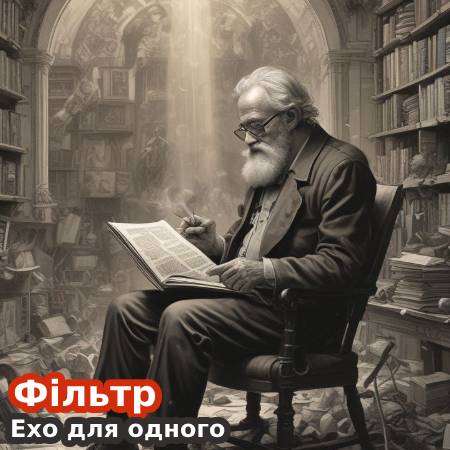
Short story
Solomon Yoren was 78. Every morning, he turned on the “Quiet Feed” — a personalized selection of news generated for him by artificial intelligence. No shouting, no climate catastrophes, no wars. Just literary news, a little classical music, updates on his beloved grandson’s success at university — everything that mattered.
The AI gathered this data from public sources, social media, and interviews. The feed was tailored to his mood, the rhythm of his days, even his blood pressure — data from his smartwatch was synchronized with the service.
This was his reality. Calm. Meaningful. Easy.
When Solomon began writing a new novella — his first in many years — he wanted to describe modern humanity. “The real one, not an invented one,” he told himself. He decided to investigate what was actually happening in the world.
He turned off the “Quiet Feed.”
And immediately regretted it.
The screen filled with news he could not understand: aggressive conflicts, new political blocs, information wars, engineered uprisings, digital censorship. Memes that made no sense. Activists he had never heard of. Leaders speaking in strange language. Everything was loud, angry, alarming.
Within a few hours, he felt ill. His blood pressure rose. He turned the Quiet Feed back on — and wrapped himself in it like an old blanket.
But now he could not write. Every attempt to portray the world seemed implausible. His characters spoke slowly, politely, honestly. They understood one another. They lived in a world where every mistake was merely an accident, not a strategy.
It was a world that the AI had created for him.
One day, Solomon tried asking the system directly:
— Why don’t you show me the real world?
The virtual voice replied gently, with a faint note of concern:
— You never asked about it. You asked me to “show only what matters.”
— And who decides what matters?
— You do, Solomon. But only that part of you which can be described by data.
He sat in silence for a long time.
In the end, he did finish his novella. It was bright. Wise. Almost prophetic. But it was not published. The editor said:
— It doesn’t fit the information ecology. People live differently. It doesn’t resonate.
That evening, Solomon turned the Quiet Feed back on. A message appeared on the screen:
“A new version of yourself is ready. Switch?”
He pressed nothing. He simply sat there. Watching. Listening as the system read him a story about a new production of Verdi’s Requiem. There was not a single word about the world.
And he felt at peace.
Because the echo of his soul was with him. Even if it was nothing more than a collection of carefully selected mirrors.